Butterfly Valve vs Ball Valve: How to Choose the Right One for Your Application
Choosing between a butterfly valve and a ball valve is one of the most common — and most consequential — decisions in industrial piping design. Both are quarter-turn valves. Both are available in manual, pneumatic and electric actuated versions. But they are built differently, behave differently under pressure, and excel in very different applications.
This guide cuts through the confusion with a straightforward, application-first comparison — so you can order with confidence.
What Is a Butterfly Valve?
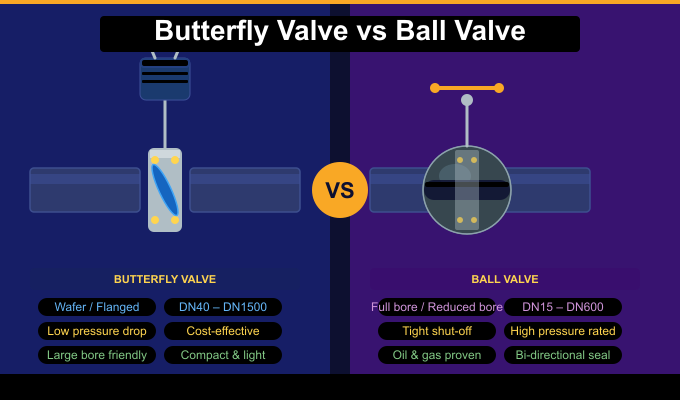
A butterfly valve controls flow using a circular disc mounted on a rotating shaft. When the shaft turns 90°, the disc swings from fully blocking the pipe bore (closed) to sitting parallel with flow (open). The disc and shaft remain inside the pipe in all positions.
This simple geometry is why butterfly valves are compact, lightweight, and cost-effective — especially in large diameters where an equivalent ball valve would be significantly heavier and more expensive.
Apollo India Valves manufactures butterfly valves in concentric, double offset and triple offset designs, available in Cast Iron, WCB, CF8, CF8M and Aluminium bodies with Nitrile, EPDM, Viton and PTFE seating — from DN40 to DN1500.
What Is a Ball Valve?
A ball valve controls flow using a spherical ball with a machined bore through its centre. When the bore aligns with the pipe, flow is unrestricted. A 90° turn seals completely. Unlike the butterfly disc, the ball moves completely clear of the flow path when open — providing zero obstruction and near-zero pressure drop.
This makes ball valves the preferred choice wherever tight shut-off, high pressure, or minimal flow restriction are critical requirements.
Apollo India Valves supplies ball valves in 1-piece, 2-piece and 3-piece designs, full bore and reduced bore, in SS 304, SS 316, WCB, CF8 and CF8M — from DN15 to DN600 in screwed, flanged and socket weld ends.
Head-to-Head Comparison
| Feature | Butterfly Valve | Ball Valve |
|---|---|---|
| Flow obstruction | Disc always in flow path | Full bore — zero obstruction |
| Pressure rating | Up to PN16 (standard) | Up to Class 1500 |
| Temperature range | Up to 220°C (PTFE seat) | Up to 450°C (metal seat) |
| Shut-off quality | Good (Class IV–VI) | Excellent (Class VI, zero leakage) |
| Size range | DN40–DN1500 | DN15–DN600 |
| Weight | Light — ideal for large bore | Heavier, especially large sizes |
| Cost | Lower, especially large sizes | Higher, especially large sizes |
| Maintenance | Simple — seat replaceable in-line | Dismantling required |
| Throttling | Good (concentric design) | Not recommended |
| Best for | Large bore, water, HVAC, general service | Oil & gas, high pressure, chemical, critical isolation |
When to Choose a Butterfly Valve
Choose a butterfly valve when:
- Your pipe diameter is DN150 or larger — the cost advantage over ball valves increases significantly with size
- The application is water treatment, cooling water, HVAC, firefighting or general utility service
- Weight and installation space are a concern — butterfly valves are compact and flange-to-flange short
- You need flow throttling capability — concentric butterfly valves regulate flow well
- Budget is a priority — a DN300 butterfly valve costs a fraction of an equivalent ball valve
When to Choose a Ball Valve
Choose a ball valve when:
- Your process involves oil, gas, steam, chemicals or any medium requiring zero-leakage tight shut-off
- Operating pressure exceeds PN16 — ball valves handle high-pressure systems that butterfly valves cannot
- The pipe diameter is DN15 to DN100 and cost difference is minimal
- You need full bore to minimise pressure drop or accommodate pipeline pigging
- The application demands bi-directional sealing — ball valves seal equally in both flow directions
- Process media is corrosive — lined ball valves with FEP or PFA lining protect against aggressive chemicals
A Note on Actuated Versions
Both valve types are available with pneumatic actuators (single or double acting) and electric actuators (230V AC / 24V DC with 4–20 mA signal). Butterfly valves typically require lower actuator torque than large ball valves — making them more economical to automate in larger sizes. Ball valves offer faster, more positive on/off response — preferred in automated systems where tight shut-off must be confirmed on every cycle.
Apollo India Valves supplies both valve types with complete actuator packages, solenoid valves, limit switches, positioners and control accessories — ready to install and integrate with your PLC or SCADA system.
Which One Does Apollo India Valves Recommend?
There is no single right answer — the correct choice depends on your specific application, pressure class, fluid type, pipe size and budget. Here is a simplified decision rule:
- Large bore + water or general service + cost sensitivity → Butterfly Valve
- Small to medium bore + oil/gas/chemical + critical isolation → Ball Valve
- High pressure (above PN16) in any size → Ball Valve
- Corrosive fluids → Lined Ball Valve (FEP/PFA) or PP Valve
Our technical team at Apollo India Valves is available to review your application and recommend the correct valve type, material class, end connection and actuation — at no charge.
Get Expert Valve Selection Support
Apollo India Valves has been supplying engineered valve solutions from our manufacturing facility in Bhosari MIDC, Pune to industries across India including Oil & Gas, Power Generation, Pharmaceuticals, Water Treatment, Chemical Process and Food & Beverage.
Whether you need a single valve or a bulk supply for a project, contact us with your line size, pressure, temperature, media and industry — and we will respond within the business day with a recommendation and quote.
📞 +91 8087013521 | +91 8087013581 ✉️ apollovalvess@gmail.com 🌐 www.apolloindiavalves.com