Most valve procurement starts the same way: a project engineer or procurement lead has a spec sheet, a budget, and a deadline, and they go looking for a supplier who can just fill the order. That works fine when the requirement is standard — a common size, a common material, a common pressure class. But a large share of industrial projects don't fit that mold. The media is unusual, the pressure rating is outside typical catalog ranges, the space constraints demand a non-standard body style, or a regulatory certification is required that most stock valves simply don't carry.
That's where a lot of suppliers quietly fall short. They can sell you what's on the shelf, but the moment a project needs something built around the actual application rather than the other way around, the conversation stalls. This is one of the main reasons buyers — across India and increasingly from international markets — end up specifically searching for a manufacturer that can handle custom valve requirements, not just distribute standard ones.
What "Custom" Actually Means in Valve Manufacturing
It's worth being precise about this, because "custom" gets used loosely in the industry. For most buyers, a custom valve requirement falls into one of a few categories:
Non-standard pressure or temperature ratings. A process might run hotter, colder, or at higher pressure than what a catalog valve is rated for, requiring a build that goes beyond off-the-shelf specifications without compromising on safety margins.
Unusual or aggressive media. Corrosive chemicals, abrasive slurries, or high-purity fluids often demand specific body materials, liners, or seat compounds that aren't part of a standard product line — PFA and FEP linings, exotic alloys, or food-grade elastomers, depending on what's actually flowing through the pipe.
Non-standard end connections or dimensions. Retrofits into existing pipeline networks, or projects with unusual flange standards, sometimes need end connections or face-to-face dimensions that don't match a catalog part number.
Specific certifications or documentation. Export projects, pharmaceutical facilities, and regulated industries frequently require material test certificates, NDT documentation, or third-party inspection reports tied to a specific standard — API, ASME, BS, or a client's internal spec — that go well beyond a basic warranty card.
Actuation and automation requirements. Not every project needs a manual handwheel. Pneumatic, electric, or signal-integrated (4–20 mA) actuation is often a project-specific requirement layered on top of the valve itself, and getting that pairing right takes more than bolting a generic actuator onto a generic valve.
A supplier that can only offer standard catalog items ends up pushing customers toward compromises on one or more of these fronts — a valve that's close enough, rather than actually right.
Why This Requires More Than a Sales Conversation
Custom valve work is fundamentally an engineering problem before it's a fulfillment problem. Getting it right means understanding the full operating picture — pressure and temperature conditions, the specific media and its compatibility with different materials, pipeline diameter, whether the valve needs to throttle or simply isolate, duty cycle, and any regulatory requirements tied to the project or the industry it serves.
This is also where in-house manufacturing capability matters more than it might seem to on paper. A business that outsources casting, machining, and assembly across multiple vendors has limited ability to adjust a design mid-process or hold tight tolerances on a non-standard build. Design, casting coordination, machining, assembly, and testing under one roof gives far tighter control at every stage — which is often the difference between a custom valve that performs reliably for years and one that becomes a recurring maintenance problem within months.
How Apollo Valves - India Approaches Custom Requirements
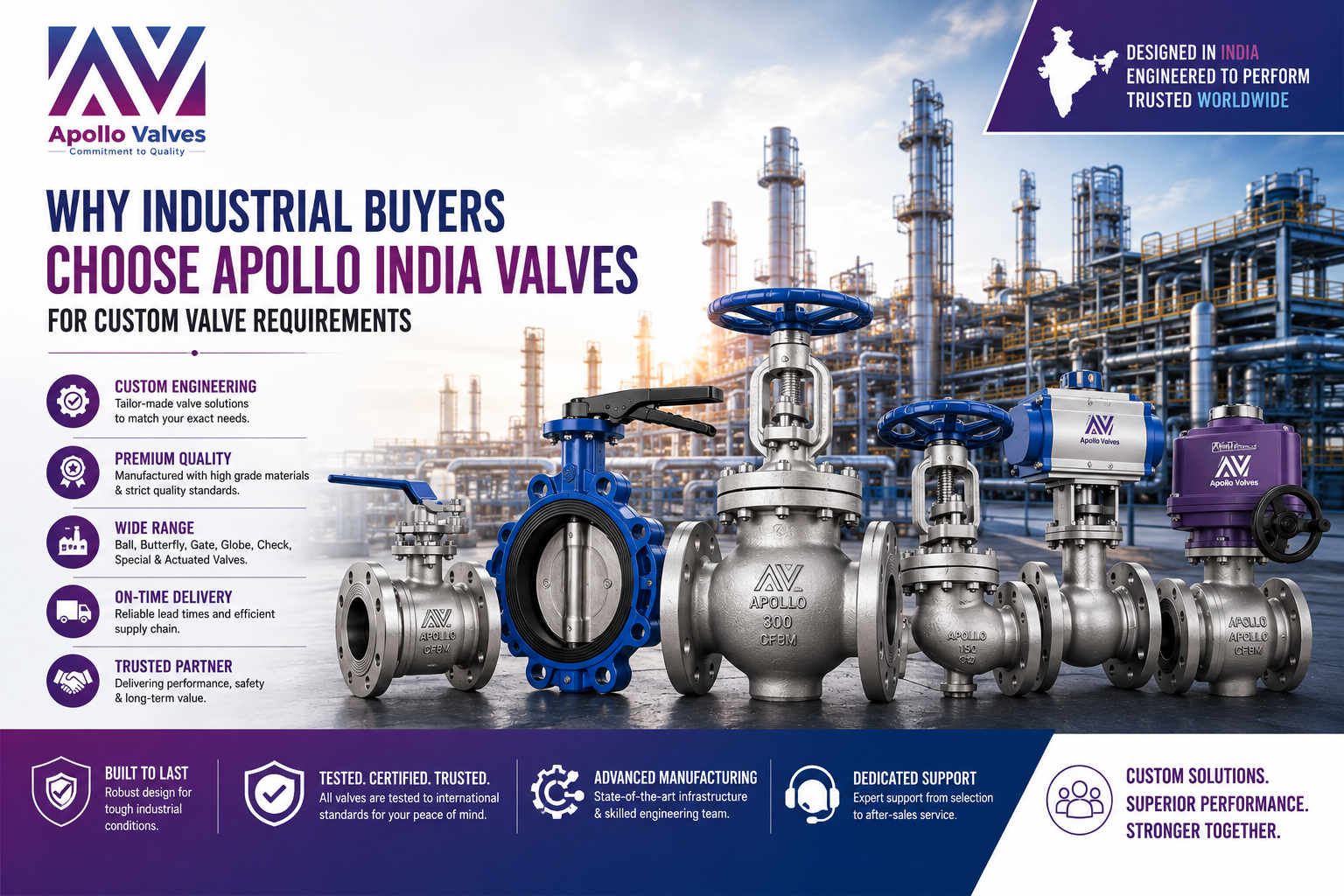
At Apollo Valves - India, custom and application-specific work isn't treated as an exception to the product line — it's built into how we operate. Our standard catalogue already spans ball valves, butterfly valves, gate valves, globe valves, knife gate valves, check valves, control valves, Y-strainers, triple offset butterfly valves, trunnion ball valves, solenoid valves, PFA lined valves, pharma-grade valves, and PP valves, across manual, pneumatic, and electric actuated configurations. But the real value for buyers with non-standard requirements is in how we handle the parts that fall outside that range.
When a customer comes to us with a project, we start with the operating conditions, not the order form — pressure and temperature, media compatibility, pipeline diameter, throttling versus isolation duty, and any certification or documentation requirements tied to the project. Sometimes that confirms a customer's initial spec is right. Sometimes it means recommending a different material, body style, or actuation setup than what was originally requested, because a valve that's wrong for the application costs far more in downtime and replacement than any savings at the point of purchase.
Every valve that leaves our Bhosari MIDC facility in Pune — standard or custom — goes through the same quality discipline: material verification against certified mill test reports, dimensional inspection, and shell, seat, and torque testing to confirm it holds under rated conditions. For projects that need it, we also carry out NDT procedures including radiography, magnetic particle inspection, ultrasonic testing, and PMI, along with third-party inspection and full export documentation for international orders. This isn't extra paperwork tacked onto a standard process — it's the same verification standard applied consistently, regardless of how unusual the specification is.
Where Custom Requirements Come Up Most
Certain industries generate custom valve requirements more often than others, simply because of how demanding or specific their operating conditions are:
- Chemical and petrochemical processing, where media compatibility often rules out standard materials entirely and lined or exotic-alloy valves become necessary.
- Pharmaceutical manufacturing, where GMP compliance, food-grade seats, and validated documentation are non-negotiable rather than optional extras.
- Oil, gas, and power generation, where high-pressure, high-temperature service pushes requirements beyond typical catalog ratings.
- Export projects, where destination-country standards, documentation, and packing requirements add a layer of specification that domestic orders don't usually involve.
- Retrofits and plant expansions, where new valves have to match existing pipeline dimensions and connection types that may no longer align with current standard offerings.
The Bigger Picture
Buyers increasingly choose Apollo Valves - India for custom requirements for a combination of reasons that are individually not unusual, but are harder to find together in one supplier: a genuinely broad product range that doesn't force a compromise before the conversation even starts, in-house manufacturing control rather than outsourced assembly, testing and documentation that holds up to real scrutiny rather than a basic warranty, and a team that treats valve selection as an engineering conversation rather than a transaction.
If your project has a requirement that doesn't fit neatly into a standard spec sheet — an unusual pressure rating, a specific material certification, a non-standard connection, or a certification requirement tied to your industry — that's exactly the kind of conversation we're set up to have.
Have a custom valve requirement for your next project? Get in touch with our engineering team, and let's work through what will actually perform for your application.