If you've spent any time around a piping layout, you already know that valve selection is one of those decisions that looks simple on paper and gets complicated fast once you factor in pressure ratings, media type, pipeline diameter, and budget. Two names come up constantly in these conversations: ball valves and butterfly valves. They're both quarter-turn valves, both widely used across industries like water treatment, oil and gas, chemical processing, and power generation, and both capable of doing the job well — just not the same job, and not in the same way.
This is one of those questions we get asked often, whether it's from a plant engineer finalizing a pipeline spec or a procurement team trying to figure out where they can save cost without compromising performance. So let's actually walk through it — how each valve works, where each one earns its place, and how to think about the decision for your specific application.
What a Ball Valve Actually Does
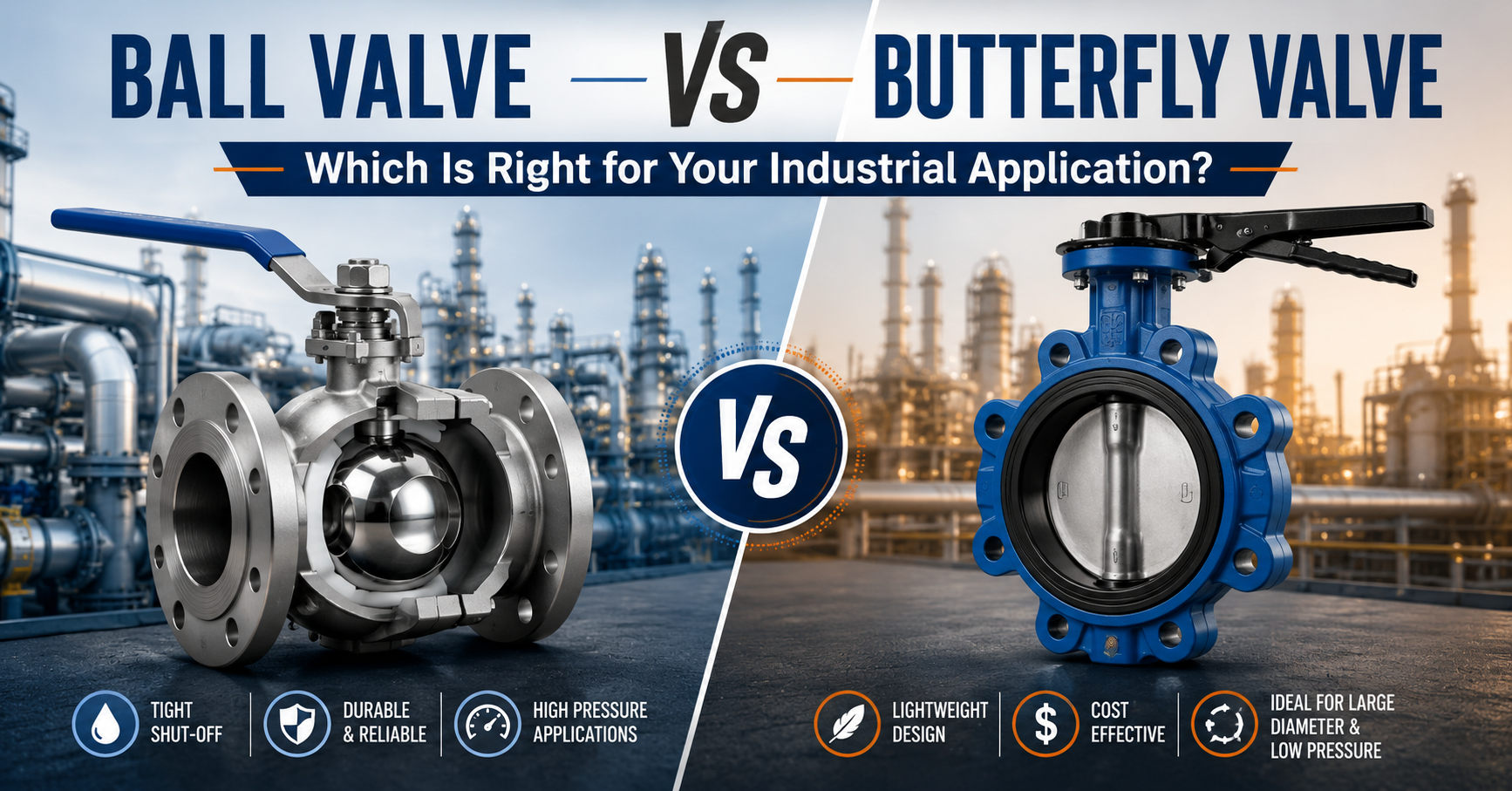
Picture a hollow ball sitting inside the valve body, with a bore drilled straight through the middle. When the valve is open, that bore lines up with the pipe, so fluid or gas moves through with almost nothing in its way. Turn the handle a quarter turn, and the ball rotates 90 degrees, closing the bore off from the flow path entirely. That's it — that's the whole mechanism, and it's part of why ball valves have stayed popular for decades. There's not much to go wrong.
What makes ball valves stand out is the quality of the seal. Because the ball presses tightly against the seats on either side, you get what's often called a bubble-tight shutoff — essentially zero leakage when the valve is closed. That matters a lot in applications where even a small amount of leakage isn't acceptable: hazardous gas lines, high-purity process fluids, or any shutoff point where safety is riding on the valve doing exactly what it's supposed to do.
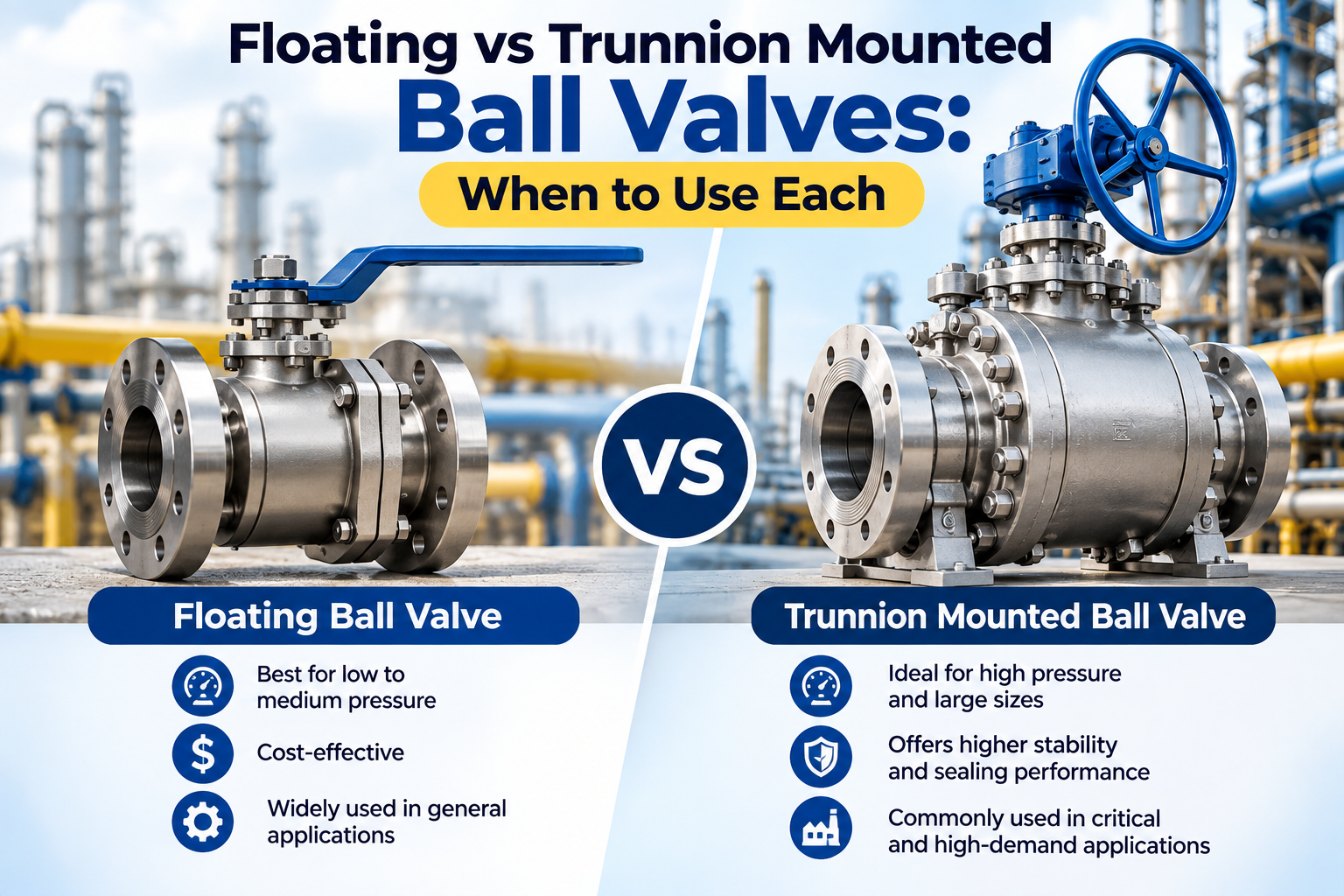
Ball valves also handle pressure and temperature extremes better than most alternatives. You'll find them in high-pressure gas pipelines, steam systems, and chemical plants where the media is aggressive and the margin for error is small. Because the bore is typically sized to match the pipe (in full-port designs, anyway), there's very little pressure drop when the valve is open, which is useful in systems where you can't afford to lose flow efficiency.
The trade-off is size and weight. As pipe diameter increases, ball valves get heavier, bulkier, and noticeably more expensive. A 4-inch ball valve is easy to justify. An 800mm ball valve on a large water main starts to look like serious capital expenditure, and that's usually the point where engineers start looking elsewhere.
What a Butterfly Valve Actually Does
A butterfly valve works on a different principle. Instead of a ball with a bore, you've got a flat disc mounted on a shaft running through the center of the valve body. Turning the shaft rotates the disc — when it's parallel to the flow, the valve is open; when it's perpendicular, the valve is closed. The disc never fully leaves the flow path, even in the open position, which is the key structural difference between the two designs and the reason their performance characteristics diverge so much.
Because the design is simpler and uses less material, butterfly valves are lighter, more compact, and considerably cheaper than ball valves once you get into larger diameters. This is really where butterfly valves win — on a 12-inch, 24-inch, or larger pipeline, the cost difference between a butterfly valve and an equivalent ball valve can be substantial, and the butterfly valve is also easier to install, easier to handle, and takes up less space between flanges.
The other thing butterfly valves do well that ball valves generally don't is throttling — that is, partially opening the valve to regulate flow rate rather than just switching flow fully on or off. Because the disc stays in the flow stream at all valve positions, you can position it anywhere between fully open and fully closed and get a reasonably predictable, controllable flow rate. Ball valves aren't built for this; partially opening a ball valve tends to cause turbulence and accelerated wear on the seats, so they're really meant to be used as on/off devices, not flow-regulating ones.
Where butterfly valves fall a little short is sealing performance. They can achieve a tight shutoff, especially with resilient-seated designs, but they generally don't match the bubble-tight seal of a ball valve, and the disc sitting in the flow path does create a small amount of pressure drop even when the valve is fully open. For most water, air, and low-to-medium pressure applications, this is a non-issue. For high-pressure or zero-leakage-tolerance systems, it can matter quite a bit.
Putting the Two Side by Side
None of this means one valve is simply "better" than the other — they're built for different jobs, and the right choice comes down to what your system actually needs.
If sealing integrity is the priority — say, you're working with a hazardous or high-purity medium, or the application involves high pressure and high temperature — a ball valve is usually the safer bet. It costs more at larger sizes, but you're paying for a level of shutoff reliability that a butterfly valve isn't really designed to match.
If you're dealing with a large-diameter pipeline, want to regulate flow rather than just switch it on and off, or need to keep both cost and installation footprint down, a butterfly valve tends to make more sense. This is especially true in water distribution networks, HVAC systems, and other applications where the media is relatively benign and the pipeline diameter is large enough that a ball valve would be impractical.
In a lot of real-world plant designs, you'll actually see both valve types used together — ball valves at critical isolation points where leak-tight shutoff is essential, and butterfly valves across the larger distribution lines where cost efficiency and flow control matter more than absolute sealing performance. There's nothing wrong with mixing and matching based on what each section of the system actually needs; in fact, that's usually the smarter engineering decision.
Why Manufacturing Quality Matters Just as Much as Valve Type
Here's the part that often gets overlooked in these comparisons: the theoretical performance of a ball valve or butterfly valve only holds up if the valve is actually manufactured to the tolerances and material standards the application demands. A poorly cast body, an inconsistent seat, or a shaft that isn't machined to spec will underperform regardless of which valve type you picked — and it'll usually show up as a maintenance headache or a failure down the line, not as an obvious defect on day one.
This is a big part of why sourcing decisions matter so much, and why so many buyers — both within India and internationally — specifically look for established butterfly valve manufacturers in India when specifying equipment for new projects. Indian manufacturing has built a strong reputation for combining solid engineering practices with cost-competitive production, which is a hard combination to find elsewhere. That's made India a go-to sourcing region not just for domestic infrastructure and industrial projects, but for buyers across the Middle East, Southeast Asia, Africa, and beyond.
Where Apollo Valves - India Fits In
At Apollo Valves - India, this is exactly the kind of decision we help customers work through every day. We manufacture a full range of ball valves, butterfly valves, and related industrial valve products, built to handle everything from municipal water systems to demanding process industry applications. Every valve that leaves our facility goes through strict quality checks — material verification, dimensional accuracy, pressure testing — because we know a valve is only as good as its weakest component, and there's no room to cut corners in this kind of equipment.
If you're not sure which valve type fits your application, or you're specifying valves for a project and want a manufacturer that understands both the engineering and the practical realities of installation and maintenance, our team is happy to walk through the specifics with you. We'll look at your pressure ratings, pipe diameter, media type, and operating conditions, and help you land on a solution that actually performs — not just one that looks good on a spec sheet.
Have a project that needs the right valve solution? Reach out to our engineering team, and let's talk through what will actually work best for your system.