Stainless steel valves play an important role in industrial systems where corrosion resistance, durability and reliable flow control are essential. From pharmaceutical manufacturing and food processing to chemical plants, oil and gas facilities, and water treatment systems, selecting the right valve material can directly affect equipment performance and maintenance costs.
However, not all stainless steel valves offer the same level of protection against corrosion, pressure or demanding operating conditions. SS304, SS316 and duplex stainless steel are three commonly considered material options, each with different properties and suitable applications.
Understanding these differences helps engineers, procurement teams and plant operators make informed purchasing decisions. It also makes it easier to evaluate the technical capabilities of the top valve manufacturers in India when sourcing industrial valves for specific operating environments.
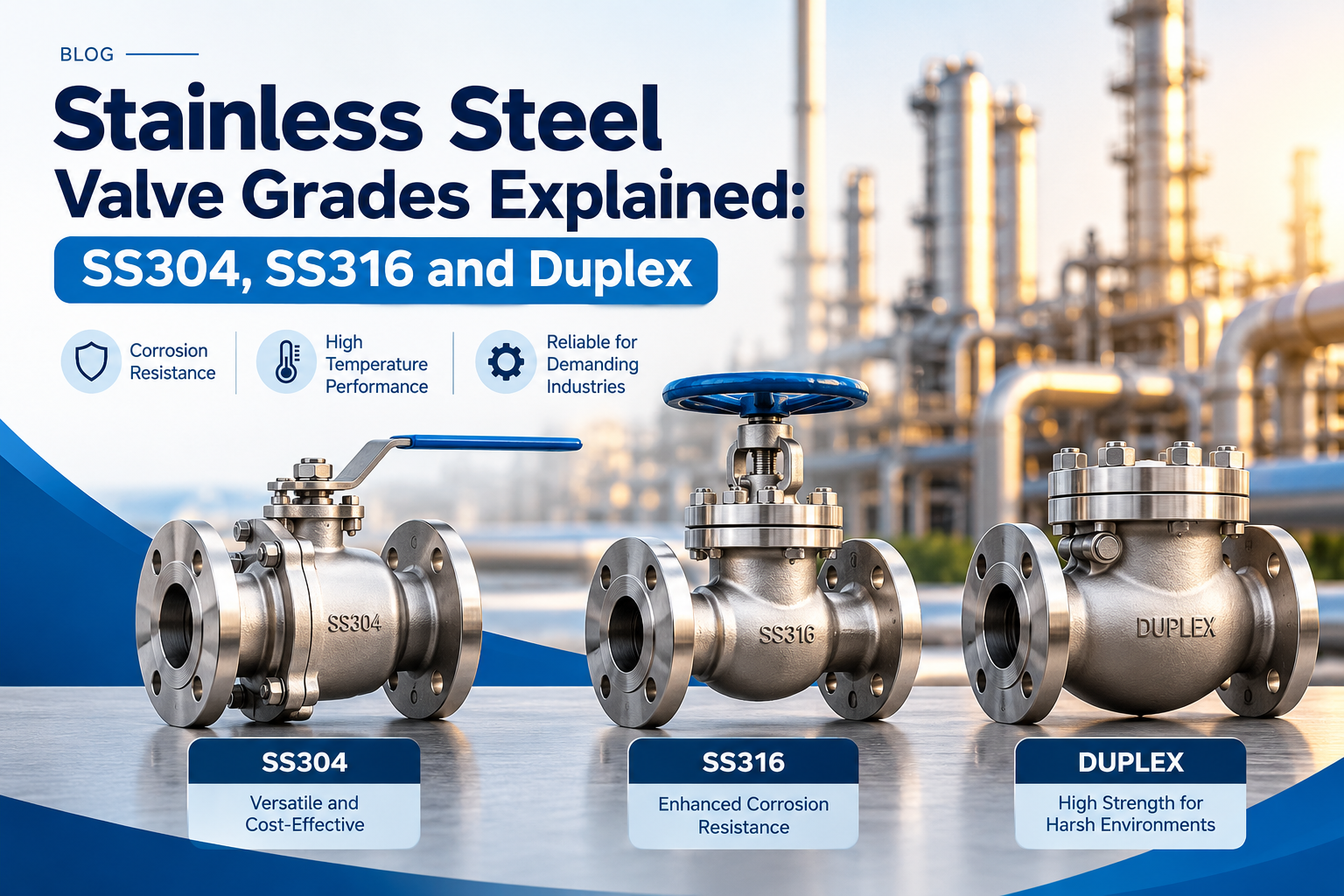
In this guide, we explain the differences between SS304, SS316 and duplex stainless steel valves, their advantages, applications and the factors to consider before selecting a suitable grade.
What Are Stainless Steel Valve Grades?
Stainless steel valve grades identify the composition and properties of the material used to manufacture a valve body, disc, ball, stem or other components.
Stainless steel contains chromium, which forms a thin protective oxide layer on the surface. This layer helps prevent corrosion under suitable operating conditions. Different grades contain varying amounts of elements such as nickel, molybdenum and nitrogen, which influence corrosion resistance, strength and other mechanical properties.
The three material categories covered in this article are:
- SS304: A widely used austenitic stainless steel suitable for many general industrial applications.
- SS316: An austenitic stainless steel containing molybdenum, offering improved resistance to pitting and crevice corrosion in many chloride-containing environments.
- Duplex stainless steel: A family of stainless steels with a mixed austenitic-ferritic microstructure, combining high strength with enhanced resistance to several forms of corrosion.
The correct choice depends on the process fluid, temperature, pressure, cleaning chemicals, chloride concentration and required service life.
1. SS304 Stainless Steel Valves: Properties and Applications
SS304 is one of the most widely used stainless steel grades in industrial equipment. It contains approximately 18% chromium and 8% nickel, although the exact composition depends on the applicable material specification.
Its combination of corrosion resistance, formability, availability and cost makes it suitable for many standard industrial applications.
Key Advantages of SS304 Valves
Good general corrosion resistance: SS304 performs well in many atmospheric, freshwater and mildly corrosive environments.
Cost-effective material selection: It is commonly more economical than SS316 and many duplex grades, making it suitable for applications that do not require enhanced chloride resistance.
Suitable for hygienic applications: SS304 is used in food processing, beverage production and certain pharmaceutical systems where the fluid chemistry and cleaning conditions are compatible with the material.
Easy availability: Its widespread use makes SS304 a practical option for many standard valve configurations and replacement requirements.
Common Applications of SS304 Valves
SS304 stainless steel valves are commonly considered for:
- Food and beverage processing lines
- General water distribution systems
- Dairy and packaging equipment
- Pharmaceutical utility systems
- Air and gas handling applications
- General industrial pipelines
What Are the Limitations of SS304?
SS304 is not suitable for every corrosive environment. It can be vulnerable to pitting and crevice corrosion in chloride-containing solutions, particularly when temperature and chloride concentration increase.
For applications involving seawater, concentrated chlorides or aggressive chemical media, engineers should assess whether SS316, duplex stainless steel or another specialised alloy is more appropriate.
2. SS316 Stainless Steel Valves: Improved Corrosion Resistance
SS316 is another widely used austenitic stainless steel grade. Its principal difference from SS304 is the addition of approximately 2–3% molybdenum, which improves resistance to pitting and crevice corrosion in many chloride-containing environments.
This makes SS316 a frequent consideration for chemical processing, pharmaceutical manufacturing and applications exposed to more demanding process fluids.
Key Advantages of SS316 Valves
Enhanced resistance to pitting: Molybdenum improves resistance to localised corrosion, although performance still depends on the specific environment.
Better performance in many chloride-containing conditions: SS316 generally performs better than SS304 in comparable environments containing chlorides. It is not immune to chloride-induced corrosion or stress corrosion cracking.
Suitable for many chemical processes: Depending on chemical concentration, temperature and exposure duration, SS316 can be appropriate for various industrial fluids.
Useful in hygienic process equipment: SS316 and SS316L are frequently specified for pharmaceutical, biotechnology and food-processing equipment where cleaning chemicals and process conditions justify the selection.
Common Applications of SS316 Valves
SS316 valves are commonly used in:
- Pharmaceutical and biotechnology facilities
- Chemical processing plants
- Selected coastal and marine applications
- Industrial water treatment systems
- Food and beverage production
- Process lines handling compatible corrosive fluids
SS316 vs SS316L: Is There a Difference?
SS316L is a low-carbon version of SS316. Its lower carbon content helps reduce the risk of sensitisation during welding, making it useful for welded equipment and piping systems.
When selecting a valve, verify the exact material designation rather than assuming that SS316 and SS316L are interchangeable in every specification.
What Are the Limitations of SS316?
Although SS316 provides improved corrosion resistance compared with SS304 in many environments, it is not a universal solution for aggressive chemicals or seawater service.
High chloride concentrations, elevated temperatures, stagnant conditions and deposits can still cause corrosion. For demanding applications, engineers should evaluate duplex or higher-alloy alternatives using the actual process conditions.
3. Duplex Stainless Steel Valves: Strength for Demanding Conditions
Duplex stainless steel contains a combination of austenitic and ferritic microstructures. This structure gives duplex grades a different balance of mechanical strength and corrosion resistance compared with conventional austenitic stainless steels.
Common duplex families include standard duplex, such as 2205, and super duplex grades, such as 2507. These grades have different compositions and performance characteristics, so the exact grade must be specified for the intended application.
Key Advantages of Duplex Stainless Steel Valves
Higher mechanical strength: Standard duplex grades generally offer approximately twice the yield strength of common austenitic grades such as SS304 and SS316, subject to the applicable specification and product form.
Enhanced resistance to pitting and crevice corrosion: Many duplex grades offer improved resistance to chloride-related localised corrosion compared with SS304 and SS316.
Resistance to chloride stress corrosion cracking: Duplex grades can provide better resistance to chloride-induced stress corrosion cracking under appropriate conditions. Performance depends on grade, temperature, stress and environment.
Potential for reduced material requirements: Higher strength can allow more efficient component design in certain applications, subject to applicable engineering codes and pressure ratings.
Common Applications of Duplex Stainless Steel Valves
Duplex and super duplex valves are considered for:
- Offshore oil and gas facilities
- Selected seawater handling systems
- Desalination plants
- Chemical processing facilities
- High-chloride industrial environments
- Demanding petrochemical applications
Are All Duplex Grades the Same?
No. Standard duplex and super duplex grades have different alloy compositions and corrosion resistance.
For example, duplex 2205 and super duplex 2507 should not be treated as identical materials. The appropriate grade depends on the required corrosion resistance, operating temperature, mechanical loads, applicable standards and process-fluid chemistry.
Duplex materials also require appropriate manufacturing, welding and heat-treatment controls. Incorrect processing can adversely affect their mechanical properties and corrosion performance.
SS304 vs SS316 vs Duplex: Key Differences
The following comparison provides a practical starting point for material selection.
| Feature | SS304 | SS316 | Duplex Stainless Steel |
|---|---|---|---|
| Material structure | Austenitic | Austenitic | Austenitic-ferritic |
| Molybdenum | Generally absent as an intentional alloying addition | Approximately 2–3% | Depends on grade |
| General corrosion resistance | Good in suitable environments | Good to very good in many more demanding environments | Often very good, depending on grade |
| Chloride pitting resistance | More limited | Improved over SS304 in many conditions | Often higher, particularly in suitable duplex grades |
| Mechanical strength | Standard | Similar general strength class to SS304 | Generally higher |
| Relative material cost | Often lower | Often higher than SS304 | Depends on grade, availability and manufacturing |
| Typical applications | General industrial service | Chemical and hygienic process service | Demanding, high-strength or chloride-rich service |
Note: This table is a general guide, not a material qualification. Actual performance depends on the specific alloy grade, valve construction, operating environment and applicable standards.
How to Choose the Right Stainless Steel Valve Grade
Choosing the right grade requires more than comparing material prices. The valve must be compatible with the process fluid and operating conditions throughout its expected service life.
1. Identify the Process Fluid
Determine whether the valve will handle freshwater, steam, chemicals, saline water, acids, cleaning solutions or a mixture of fluids. Obtain the relevant concentration and chemical compatibility information.
2. Check Operating Temperature and Pressure
Temperature can significantly affect corrosion behaviour and mechanical performance. Pressure ratings also depend on valve design, wall thickness, end connections, material specifications and applicable standards.
Do not select a valve based only on its stainless steel grade.
3. Evaluate Chloride Exposure
For applications exposed to chlorides, assess concentration, temperature, flow conditions and the possibility of stagnant zones or deposits. SS316 may provide an improvement over SS304, while duplex grades may be appropriate for more demanding conditions.
4. Consider Fabrication and Maintenance
Welding requirements, cleaning procedures, surface finish, inspection access and replacement-part availability all influence the practical choice of material.
5. Verify Valve Standards and Testing
Check the applicable manufacturing and testing standards, pressure class, leakage requirements, material certificates and inspection documentation. Where necessary, request evidence of material traceability and relevant test reports.
Working with experienced suppliers helps ensure that the material, valve design and documentation meet the project's requirements.
How to Evaluate the Top Valve Manufacturers in India
When searching for the top valve manufacturers in India, buyers should look beyond product availability and quoted price. The manufacturer's ability to supply the correct material, pressure rating and valve configuration is equally important.
Consider the following factors before placing an order:
- Material specifications: Confirm whether the valve body and internal components match the required grade.
- Product range: Check availability of ball, butterfly, gate, globe, check and other application-specific valves.
- Quality assurance: Review applicable certifications, manufacturing controls and inspection procedures.
- Testing and documentation: Request relevant pressure-test reports, material certificates and compliance documents.
- Application support: Choose a supplier that can help clarify fluid compatibility, actuation, pressure ratings and connection requirements.
- After-sales support: Evaluate spare-part availability, technical assistance and delivery commitments.
These checks help procurement teams compare manufacturers against the actual requirements of their projects rather than relying on broad marketing claims.
Find the Right Industrial Valve Solution with Apollo India Valves
Selecting between SS304, SS316 and duplex stainless steel depends on the operating environment, corrosion risks, mechanical requirements and total cost of ownership. SS304 is widely used for general industrial applications, SS316 offers improved resistance to many chloride-related corrosion conditions, and duplex stainless steel provides higher strength with enhanced corrosion resistance in suitable applications.
For buyers evaluating the top valve manufacturers in India, the priority should be finding a supplier that can match the valve material and design to the actual process requirements, with appropriate testing and documentation.
Apollo India Valves supplies a range of industrial valve solutions, including manual, electric-actuated, pneumatic-actuated and specialised valve options. Its product range includes stainless steel valve configurations for applications across pharmaceutical, chemical, water treatment and other industrial sectors.
Before finalising a valve, discuss your process conditions, material requirements, pressure rating and testing needs with the supplier.
Explore industrial valve solutions and request product information from Apollo India Valves.